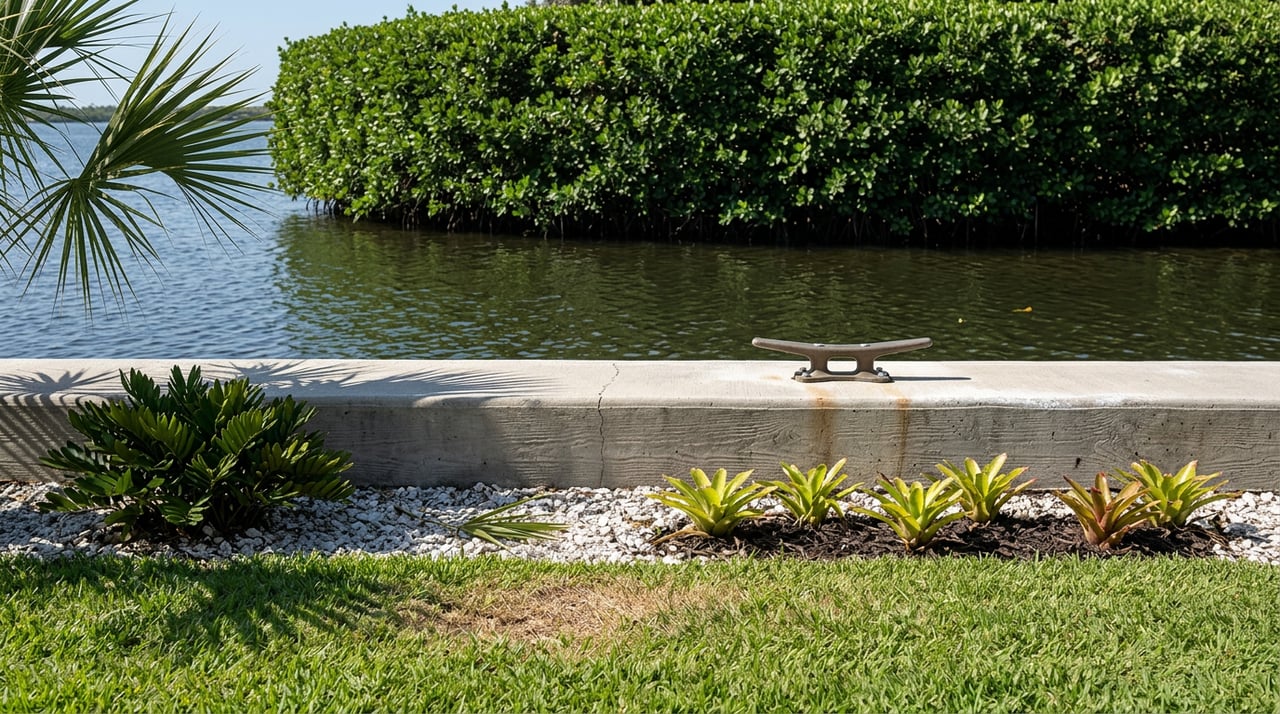
The Marine Permit File: Why Boca Raton Waterfront Sellers Win or Lose the Closing Before the First Showing
July 23, 2026
July 23, 2026
Most sellers preparing a waterfront estate in Boca Raton spend the pre-listing weeks on the parts a buyer can see. New landscape lighting. Refinished teak. A pressure-washed dock. What actually decides whether the transaction closes on the original timeline, or slides into a renegotiation, sits in a file cabinet: the seawall, dock, and boat-lift permit history.
In a $5M-and-up waterfront segment where buyers arrive with proof of funds and short diligence windows, the marine paper trail is the closing timeline. A complete, closed file compresses a buyer's inspection scope to about ten days. A gap in that file finances itself, quietly, through holdbacks, re-inspection extensions, and price reductions the seller never modeled.
Before the survey, before the elevation certificate, before the four-point insurance inspection, a well-represented waterfront buyer asks for one thing: the permit history for every structure touching the water. Seawall panels and cap. Dock decking and piles. Boat lifts and canopies. Any dredging or shoreline stabilization the current owner or a predecessor performed.
The reason is simple. If previous owners made changes without permits, it can complicate insurance, refinancing, or resale, and permit history should be verified with the City of Boca Raton and Palm Beach County before closing. That verification takes time the buyer does not have if they want to close in thirty to forty-five days. Sellers who arrive at the listing appointment with a closed, indexed file effectively hand the buyer back that time.
The gap between "there's a dock permit somewhere" and "the file is closed" is defined by Chapter 22 of the City of Boca Raton Code of Ordinances and the City's Engineering Design Standards Manual, Section 7.7 of which was updated in January 2025. A plan set that will actually close its inspections has to show, at minimum:
When any of those elements is missing from the as-built package, a buyer's engineer flags it. The buyer's counsel then asks the seller to either produce the missing document, cure the permit at the city, or accept an escrow holdback until the file is closed. All three cost time. Two of the three cost money.
A single marine improvement in Boca often touches four agencies rather than one. Waterfront work often needs approvals at the city, county, state, and federal level, and within city limits the Building Division issues permits for seawalls, docks, and related shore structures. Outside city limits, Palm Beach County permitting and Environmental Resources Management handle dock and seawall reviews. The Florida Department of Environmental Protection regulates coastal construction, and work seaward of the Coastal Construction Control Line requires special authorization. Federal review through the U.S. Army Corps of Engineers is triggered when the scope reaches navigable waters or submerged lands.
Layered review is not just an administrative footnote. These projects involve multiple regulatory agencies including the local building department, the Florida Department of Environmental Protection, the Army Corps of Engineers, and in some cases the Florida Fish and Wildlife Conservation Commission, and permit complexity for marine construction substantially exceeds standard residential permits. That is why a permit opened three owners ago and never closed can sit dormant for a decade and still surface on a title commitment the week before closing.
Elevation is the second timing accelerator. Regional coastal-resilience guidance in South Florida is measured in the North American Vertical Datum of 1988, with land elevations along tidal waterways varying from six to eight feet NAVD 88 in northern parts of the county to one to four feet NAVD 88 in southern parts, and property-specific variability throughout. A seawall cap elevation that satisfied the building official when it was poured may not satisfy an underwriter now. The seller who has an engineer's letter tying the current cap to a NAVD 88 datum removes that question before it can be asked.
Insurance underwriting is where quiet marine issues become loud transactional ones. Seawalls help reduce erosion and local wave action, but they do not remove flood risk. FEMA flood zones, base flood elevation, and elevation certificates still drive flood insurance needs and pricing. Docks, lifts, and other water structures may require specific endorsements on a homeowner's policy, and insurers often ask for maintenance records or recent inspections.
The pattern shows up in a specific way at the end of a Boca waterfront closing. A buyer secures a bindable quote at contract, then the carrier requests documentation before final binding: an elevation certificate, a recent seawall condition report, sometimes underwater imagery. If the seller cannot produce those inside the diligence window, the buyer's lender delays clear-to-close. The transaction now depends on a marine engineer's schedule, not the seller's.
An engineer's inspection is not exotic in this market. An inspection typically covers the panels, cap, drainage or weep holes, soil stability, and any signs of cracking, bowing, or corrosion, and in some cases underwater assessments are performed to check conditions below the surface. Ordered before listing, it becomes an asset. Ordered under contract, it becomes a bottleneck.
For an exclusive Boca waterfront listing, the file we assemble before the property goes live generally contains, in this sequence:
The buyer's team can move through that stack in a single meeting. If previous owners made changes without permits, it can complicate insurance, refinancing, or resale, and this is the seller's opportunity to answer the question before it is asked.
There is a specific move that becomes available to sellers who have this file ready, and it is the reason the file is worth building. Instead of a broad, exploratory diligence period, the seller can invite a targeted one: seawall, envelope, insurance. Ten days rather than thirty. An escrow holdback narrowed to any open permit close-out rather than a general reserve against unknown marine risk.
The seller who produces a closed marine file is not selling paperwork. They are selling certainty of close, and certainty at $5M and above is a price.
That trade is not theoretical. In the current Boca waterfront market, buyers with cash and short timelines will pay for the certainty that their diligence will not spiral. A well-documented seller who prices with discipline can, in the right transaction, accept a headline number that is not the highest offer and still net more, because the deal actually funds on the original date and without a late-inning credit.
Do I have to disclose an old seawall repair that was done without a permit? A Florida real estate attorney should answer disclosure questions specific to a property, but as a matter of transactional reality, the item will surface in the buyer's permit search. Disclosing it up front, with a plan for how it will be resolved (cure at the city, engineer's letter, escrow holdback), is a stronger position than waiting for it to be found.
Is a Boca seawall required to be a specific minimum height? The city's design standards reference an engineered cap elevation rather than a single citywide number, and regional guidance is expressed in NAVD 88 feet. The right answer for a specific property is the elevation on the sealed survey, tied to the manual in force when the wall was permitted, and confirmed by a licensed marine engineer.
Should I replace the seawall before listing, or price for it? It depends on the condition report and the buyer pool the property will attract. A wall with a clean engineer's letter and ten years of remaining service life is usually better disclosed and left alone. A wall with active deterioration is usually better addressed pre-listing, because the buyer's discount will exceed the repair cost once insurance and financing enter the conversation.
Who pulls the permit history? Owners can request permit records from the City of Boca Raton Development Services and from Palm Beach County directly. In a listing engagement, our team coordinates those requests, along with the marine engineer and surveyor, so the file is complete before photography.
Boca Raton's waterfront market rewards preparation you cannot see from the street. If you are considering a sale on the Intracoastal, an interior canal, or the ocean, Schedule a private consultation with The Weppner Group and we will begin with the file, not the photography.
Stay up to date on the latest real estate trends.

Our team is here to help you through every step of your journey, whether you’re buying or selling, and we would be honored to assist you in finding your next home or investment. We are excited about the opportunity to serve you and look forward to helping you create the future you envision.